
Artifactory Under Siege: Lessons for Server Security
Artifactory Under Siege: Lessons for Server Security
When a Repository Becomes a BackdoorIn the summer of 2026, a series of intrusions against self-hosted JFrog Artifactory instances demonstrated how qui...
When a Repository Becomes a Backdoor
In the summer of 2026, a series of intrusions against self-hosted JFrog Artifactory instances demonstrated how quickly an exposed development service can turn into an attacker's foothold. Between mid-August and early September, attackers chained vulnerabilities to move from unauthenticated requests to full administrative control, creating persistent accounts and deploying backdoors. In some cases, the entire escalation took less than five minutes. For system administrators, hosting providers and SMEs running their own infrastructure in Spain and across Europe, the incident is a stark reminder that application security cannot be separated from server hardening.
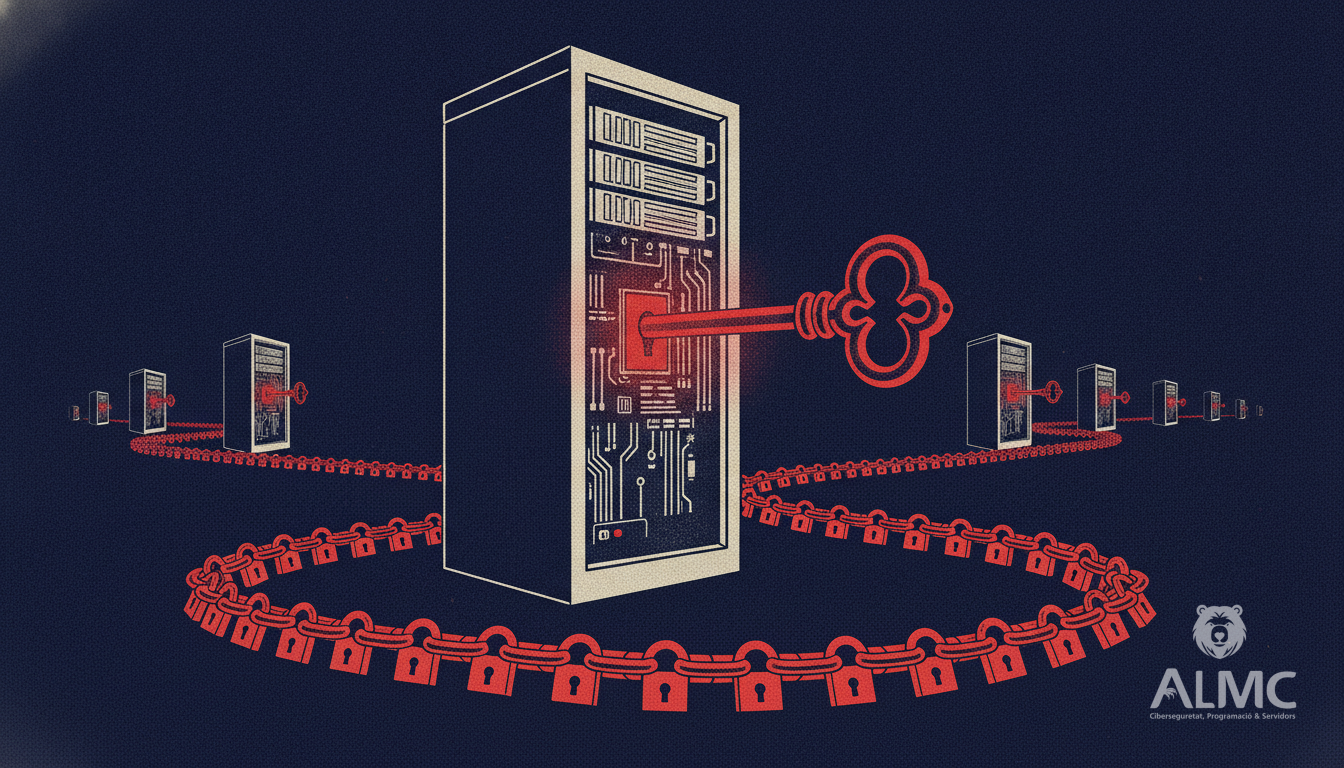
How the Attack Unfolded
The primary vector combined two flaws. One allowed an attacker to obtain an internal token associated with the anonymous user without logging in, even when anonymous access was disabled. The second flaw then permitted the exchange of that low-privilege token for one with administrative scope. The validation checked the signature and issuer but not the actual permissions embedded in the token, effectively turning a minimal access point into a master key. A separate critical authentication bypass, rated 9.8 on the CVSS scale, allowed direct administrative access on default configurations. Once inside, attackers installed malicious Groovy plugins to achieve code execution, ran shell commands for reconnaissance, and deployed a Rust-based backdoor for remote control. They also created admin tokens and enumerated users, groups and credential sets, preparing for persistence.
Why Traditional Defences Fall Short
Many organisations rely on perimeter firewalls and application patching alone. But these attacks show that a single unpatched service can lead to full server compromise, bypassing network controls. The use of anonymous tokens also complicates forensic analysis: administrative actions may appear in logs as token:anonymous rather than a named account, delaying detection. Moreover, the attacker's ability to install plugins and execute code means that even after patching, hidden persistence mechanisms may remain. This is where a layered, server-level security strategy becomes essential.
Centralised Protection with Abuse Shield
At ALMC, we have developed Abuse Shield to address exactly these gaps. It centralises the protection of your servers by automatically blocking malicious IPs, managing fail2ban across multiple machines, and sharing an IP reputation feed between all your servers. When one server detects an attack, the others learn from it immediately. For hosting companies and SMEs with several servers, this means a coordinated defence that adapts in real time. Abuse Shield does not replace patching, but it adds a critical layer: it reduces the attack surface by blocking known malicious actors and limiting the opportunities for exploitation, even before a patch is applied.
Immediate Steps for Administrators
If you run Artifactory or similar services, act now:
- Update to the latest patched versions. For the authentication bypass, fixes are available in the 7.x branches; applying any one of the patches breaks the chain.
- If immediate updating is not possible, set a random extra join key in system.yaml as a temporary containment measure.
- Review audit logs for administrative actions linked to token:anonymous and for newly created privileged accounts.
- Rotate all credentials and tokens that may have been exposed.
- Audit changes to users, groups and federated access topologies.
- Inspect the server for unauthorised Groovy plugins and remove suspicious extensions.
- Check the file system and scheduled tasks for binaries in paths like /tmp and signs of command-and-control connections.
- Verify the integrity of critical repositories and artefacts, and reinforce publication controls in your CI/CD pipeline.
Building a Resilient Server Security Posture
Beyond incident response, prevention requires a mindset shift. Server security must be continuous, not reactive. This includes regular patching, least-privilege access, network segmentation, and monitoring for anomalous behaviour. Tools like Abuse Shield complement these practices by providing automated, cross-server defence. For businesses in Barcelona, Lleida, Tarragona or Girona, where digital infrastructure underpins daily operations, investing in robust security is not optional. It protects not only your data but also your customers' trust and your compliance with GDPR.
The Supply Chain Dimension
A compromised Artifactory is not just a breached server; it can become an injection point for malicious components into legitimate software. Attackers can alter artefacts, backdoor builds, and propagate compromise downstream. This is why integrity checks and strict promotion controls in CI/CD are vital. Abuse Shield helps by blocking the IPs of known malicious actors, making it harder for attackers to maintain a foothold and exfiltrate data. However, it must be part of a broader strategy that includes code signing, artefact scanning, and access reviews.
Conclusion
The Artifactory attacks are a wake-up call. They show that even well-managed services can be breached through chained vulnerabilities, and that speed is of the essence. By combining timely patching with centralised server protection like Abuse Shield, administrators can significantly reduce risk. At ALMC, we help organisations across Catalonia and Spain secure their infrastructure with practical, effective solutions. Do not wait for an incident to review your defences.
Related
- How to Harden Your Servers with Fail2ban and IP Reputation Feeds
- Fail2ban: Your First Line of Defense Against Unauthorized Server Access
- Critical libssh2 flaw: urgent patch for SSH servers
- Desarrollo web
Put these ideas into practice
Talk to ALMC about a solution for your business. Explore your options or contact our team.