
When Fridges Turn Into Heaters: Server Security Lessons
When Fridges Turn Into Heaters: Server Security Lessons
A sabotage that turned cooling into heatingIn the early hours of 11 October 2026, several French supermarket chains woke up to an unusual problem: the...
A sabotage that turned cooling into heating
In the early hours of 11 October 2026, several French supermarket chains woke up to an unusual problem: their refrigeration systems were not cooling, they were heating. Attackers had reached the control layer that governs commercial refrigeration and manipulated defrost cycles and temperature setpoints until cabinets reached around 50 °C. The result was the loss of tonnes of meat, fish, dairy and prepared meals that could no longer be sold once the cold chain broke. Around 150 stores of one chain were reported among the most affected, with other operators also registering incidents.
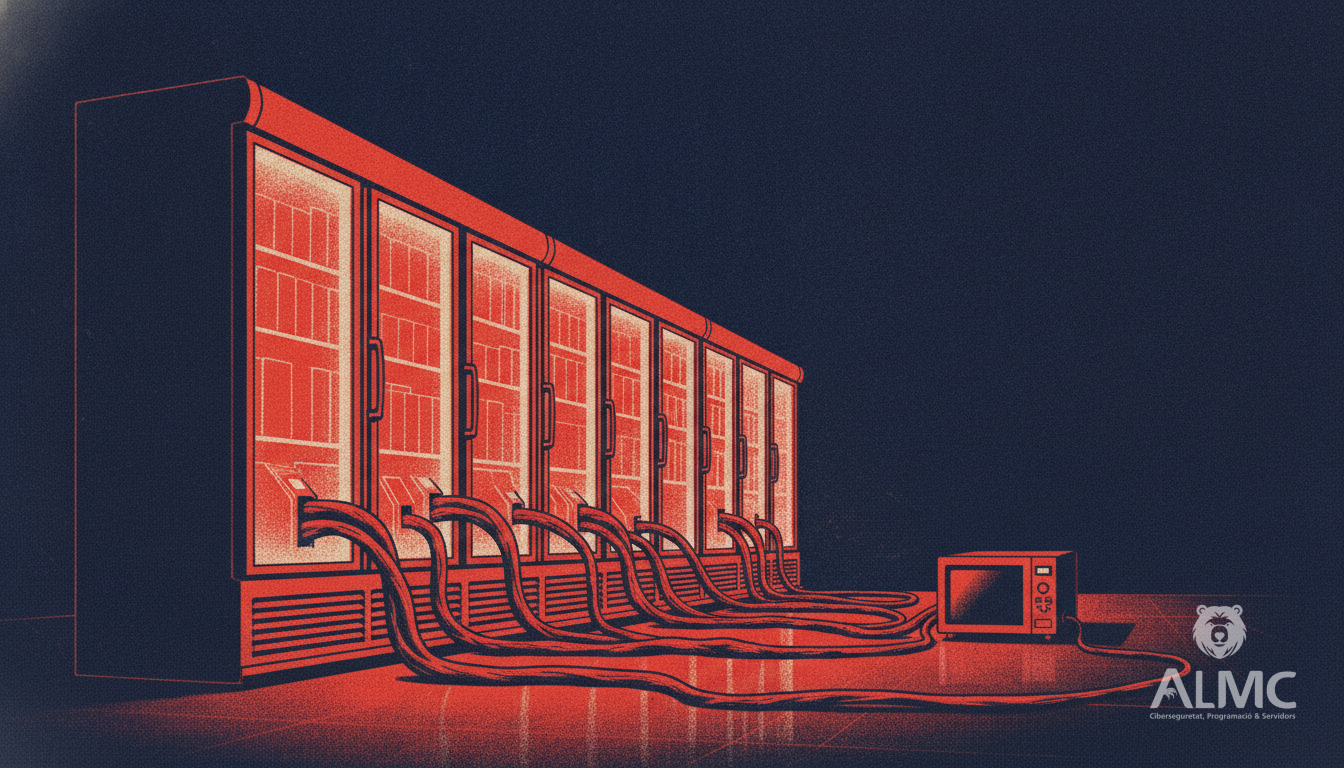
It is tempting to read this as a story about food waste. It is really a story about what happens when an exposed administrative interface sits between the internet and the physical world. The same pattern applies to any business in Catalonia or Spain running its own servers, from a hosting company in Barcelona to a small firm in Lleida with a single rack in a colocation facility.
What the technical investigation actually showed
A few weeks before the sabotage, a security research team published a study on a family of commercial refrigeration controllers. The research documented how several vulnerabilities could be chained to bypass authentication, reach remote command execution and alter the configuration of the integrated web server. The researchers did not claim this was the exact method used in France, and no public confirmation exists. But the hypothesis is technically plausible, and that is enough to draw lessons.
The controller in question is not a simple networked thermostat. It is a centralised manager that supervises refrigeration circuits, sets temperature thresholds, handles alarms and adjusts schedules. Compromising that administration point gives an attacker access to functions with direct physical consequences. The researchers began by scanning internet-wide platforms and identified thousands of publicly reachable interfaces. Not all were vulnerable or compromised, but the attack surface was reachable without first entering a corporate network.
Why layered architectures hide the real risk
Once a device is identified, the next step is firmware analysis. In this case, the web interface sat on top of a more complex chain: an external web server received requests, certain script paths were forwarded to an internal component, and another layer processed the application logic. Authentication, request validation and the actual operation could live in different places.
This matters because looking only at what the browser shows is not enough. A vulnerability can hide in the path between the entry point and the function that performs the operation. In the reported case, an alternative authentication route accepted a code calculated from the device date instead of checking the configured administrative password. That is not a weak password problem or a brute-force problem. It is a design problem: a maintenance feature became an entry point because its activation conditions were not sufficiently protected.
The uncomfortable common ground with everyday servers
Most SMEs and hosting providers do not manage refrigeration controllers. They manage Linux servers, web applications, databases and remote access services. The underlying failure modes are remarkably similar:
- Administrative interfaces reachable from the internet without strict access control.
- Alternative authentication paths, legacy endpoints or support features that bypass the normal login.
- Firmware or software that is not updated because the device "works fine".
- No centralised view of which machines are exposed and which ones are being probed.
In Spain, GDPR adds another layer. A compromised server that holds personal data can trigger notification obligations to the Spanish data protection authority and to affected individuals. The cost is not only operational; it is legal and reputational.
Centralising protection instead of patching one by one
The practical response is not to buy a new appliance. It is to treat every server as part of a single security perimeter. That means automatic blocking of malicious IPs, managed fail2ban across multiple machines and a shared reputation feed so that an attack detected on one server protects the rest. When a hosting provider in Tarragona sees repeated login attempts against one customer's VPS, that signal should harden every other server in the fleet, not just the one being targeted.
This is the approach behind Abuse Shield: centralised server protection with automatic IP blocking, managed fail2ban on multiple machines and a reputation feed shared across all of them. For system administrators, hosting companies and SMEs with their own servers in Girona, Lleida or anywhere else, it turns isolated reactions into a coordinated defence.
Five practical measures for connected infrastructure
- Inventory every administrative interface, including controllers, panels and remote access tools, and check whether it really needs to be reachable from the internet.
- Apply firmware and software updates as soon as security advisories appear, not when the next maintenance window happens to arrive.
- Replace single-password access with multi-factor authentication wherever the device supports it.
- Deploy fail2ban or an equivalent tool on every server, and share ban lists between machines so that one detection protects the whole fleet.
- Monitor outbound and inbound traffic for anomalies, because a compromised controller or server often behaves differently before it causes visible damage.
The French incident is a reminder that the gap between a misconfigured interface and a physical consequence is smaller than it looks. Whether the asset is a refrigeration cabinet or a web server, the question is the same: who can reach the administration layer, and what happens when they do?
Related
- How to Harden Your Servers with Fail2ban and IP Reputation Feeds
- Fail2ban: Your First Line of Defense Against Unauthorized Server Access
- Critical libssh2 flaw: urgent patch for SSH servers
- Desarrollo web
Put these ideas into practice
Talk to ALMC about a solution for your business. Explore your options or contact our team.